Editorial independence: our scores and rankings are produced using the fixed criteria above and are not influenced by advertisers. This is an independent ranking site and is not operated by, or affiliated with, any provider we list.
Affiliate disclosure: some links on this page may earn us a commission at no extra cost to you. This does not affect our rankings.
Live market data via CoinGecko, for informational purposes only. Not financial advice.
| Best for | Not for |
|---|---|
| Operating history dating to 2013 | Broker quotes may trail order-book pricing |
Criteria Breakdown
| Criterion | Score | Notes |
|---|---|---|
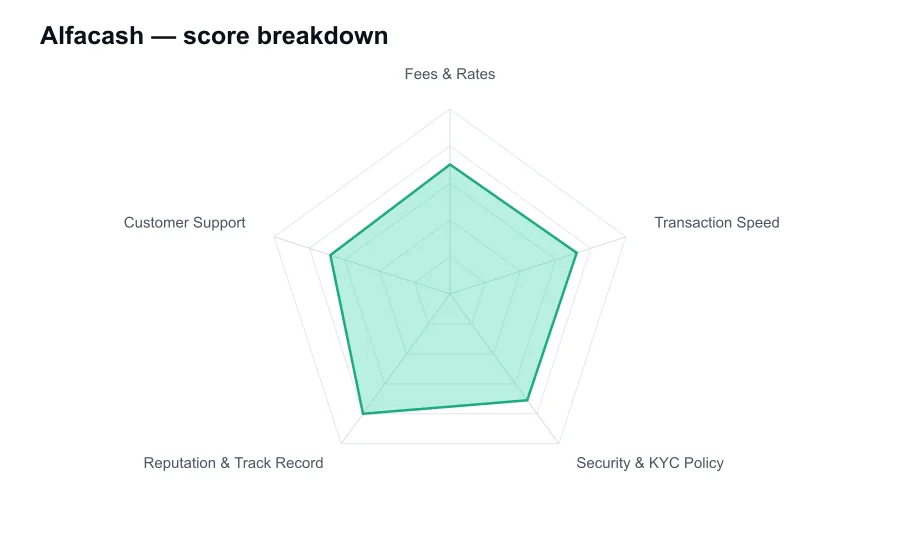
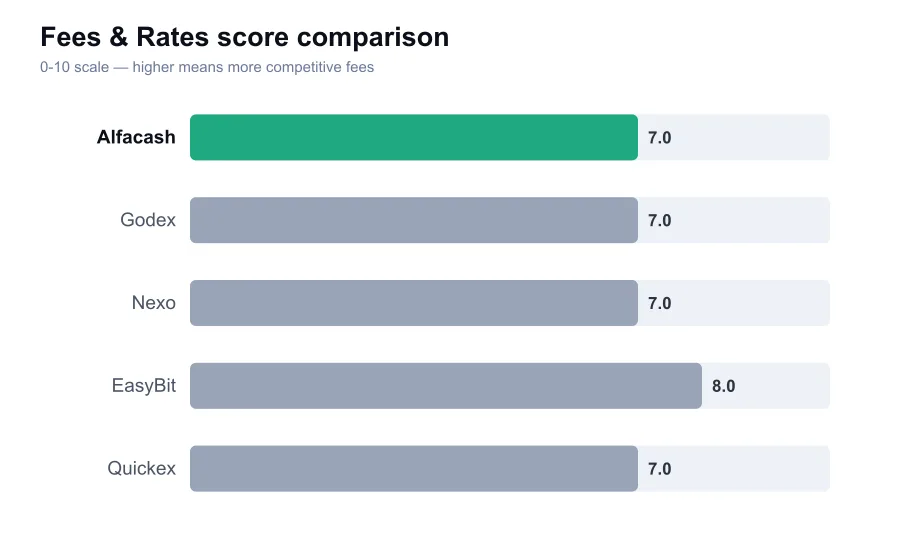
| Fees & Rates | 7.0 | Historically around 0.5% for swaps, payment routes cost more |
| Transaction Speed | 7.2 | Routine crypto swaps are usually prompt after confirmation |
| Security & KYC Policy | 7.1 | Established AML controls and short-duration custody model |
| Reputation & Track Record | 8.0 | Operating since 2013, unusually long-lived for this niche |
| Customer Support | 6.8 | Longstanding online support, but no premium exchange desk |
In-Depth Review
Alfacash is one of the older names in the instant cryptocurrency exchange niche. Founded in 2013, it predates much of the current crop of swap widgets and has survived enough market cycles to carry more weight than a newly launched conversion site. It is not a mainstream order-book exchange like Kraken or Coinbase, and it is not trying to be. Alfacash is built for straightforward buying, selling and exchanging of digital assets.
That longevity is meaningful. Crypto users have seen many services arrive with aggressive promises, then disappear after a bear market, banking dispute or liquidity squeeze. Alfacash's continued presence does not make it risk-free, but it gives the platform a much stronger starting point on reputation than most small instant exchangers. It has had years to develop payment routes, support processes and a recognizable identity in a market where trust is expensive.
The product is still best understood as a broker-style exchange service. Customers see a rate, select a payment or crypto route and complete the transaction. That is easier than navigating a trading terminal, but it rarely produces the lowest possible price. Alfacash earns through the rate it quotes, payment-processing costs and the liquidity spread behind the transaction. Users looking for institutional-style fee precision will find the model less satisfying than a transparent maker-taker schedule.
The service has historically advertised exchange fees around 0.5 percent for crypto-to-crypto conversions, although the effective total cost depends heavily on the pair, amount, payment method and network fees. Card purchases are naturally more expensive because payment processors and fraud controls add cost. The practical lesson is simple: crypto-to-crypto swaps are usually where Alfacash makes the most economic sense. Buying with a card is convenient, but convenience comes at a price.
I appreciate that the platform has long offered more than a bare anonymous swap form. It has supported a range of cryptocurrencies and payment methods, including options that are useful in regions underserved by the largest exchanges. That breadth has always been part of its appeal. A person who cannot or does not want to use a full exchange account may find Alfacash's route far less burdensome than a bank-linked trading platform.
Speed is generally good for the type of service it is. A crypto-funded exchange can often be completed after the required blockchain confirmations, while card and bank-related purchases depend on payment approval and compliance checks. It is realistic to expect a routine crypto swap to take minutes to perhaps an hour, not to assume that every conversion will be immediate. Bitcoin and Ethereum congestion can push that timeline out, and payment transactions may take longer still.
The platform is strongest on uncomplicated, supported routes. If you send the exact asset, on the exact network, to the address shown, the process is usually easy to follow. Problems begin with the same issues that trouble every broker exchange: underpayments, wrong-chain deposits, missing destination tags and delayed confirmations. Users should not assume a support team can recover every operational error, especially where a blockchain transfer itself cannot be reversed.
Alfacash's KYC policy is more nuanced than the phrase no registration suggests. It has historically allowed many exchanges without a traditional account, but it can request identity documents and other information under its AML procedures. This is standard for a long-running business that works with payment providers and liquidity partners. The important point is that a transaction can be reviewed after it has been initiated. Anyone who may refuse verification should not use a route where funds could be held pending review.
From a security perspective, the short-duration exchange model is preferable to leaving an idle balance on an exchange for months. Alfacash is not asking customers to treat it as a long-term wallet. Funds are meant to pass through during the conversion. Yet users still assume counterparty risk during that period, so it remains wise to use a personal wallet for storage and to avoid sending a life-changing sum in a single first transaction.
Its reputation is solid for an instant exchanger, though it does not have the regulatory depth, audited reserve reporting or public financial disclosure associated with the biggest centralized exchanges. That comparison should be kept fair. Alfacash is a smaller broker-style service with a different operating model. Its advantage is its age and continuity. Its limitation is that users still have to rely more on the operator's execution than they would on a fully transparent order book.
Support has been an important part of Alfacash's survival because exchange services live or die on handling exceptions. The company provides online support and documentation, and its long history means there is substantially more user discussion to examine than for a newly created swap site. I would still prefer clearer real-time status information on every order and more explicit public explanations of how unusual cases are resolved. Those details reduce anxiety during delays.
For pricing, Alfacash should be judged against the right competitors. It will often be easier than moving funds into an exchange, trading and withdrawing again. It will not always beat Kraken, Binance or Coinbase Advanced on raw execution cost, particularly for liquid large-cap pairs. Against other instant services, it can be competitive, but the result is pair specific. Never rely on a generic claim that any swap provider is cheap.
The ideal customer is someone who values a mature, simple conversion service and is willing to pay a modest premium for it. It can also suit users who need access to payment or asset routes not available through their usual exchange. The wrong customer is a high-frequency trader, a large-volume desk or someone who demands immutable fee tables and deep market data. Alfacash is a broker, not a pro trading venue.
My view is favorable, with conditions. Alfacash has earned more trust than most instant exchangers because it has been operating since 2013 and has a coherent, practical service. Its price is not automatically the best, and KYC review remains possible, so it should not be romanticized as a frictionless anonymous shortcut. For normal-sized swaps, particularly crypto-to-crypto conversions, it is one of the more credible options in its category.
Pros & Cons
| Pros | Cons |
|---|
What does Alfacash charge for a crypto exchange?
Alfacash has historically cited exchange fees around 0.5 percent, but the final cost varies by pair, liquidity, network fees and payment method. Check the final payout on the live quote.
Does Alfacash require an account?
Many exchanges can be initiated without opening a conventional trading account. However, Alfacash may request KYC information for AML, payment or transaction-risk reasons.
Is Alfacash suitable for storing crypto?
No. It is designed as an exchange service, not a long-term custody solution. Send the purchased or exchanged assets to a wallet you control.