Editorial independence: our scores and rankings are produced using the fixed criteria above and are not influenced by advertisers. This is an independent ranking site and is not operated by, or affiliated with, any provider we list.
Affiliate disclosure: some links on this page may earn us a commission at no extra cost to you. This does not affect our rankings.
Live market data via CoinGecko, for informational purposes only. Not financial advice.
| Best for | Not for |
|---|---|
| Established instant-exchange brand | Quotes can be beaten by competitors |
Criteria Breakdown
| Criterion | Score | Notes |
|---|---|---|
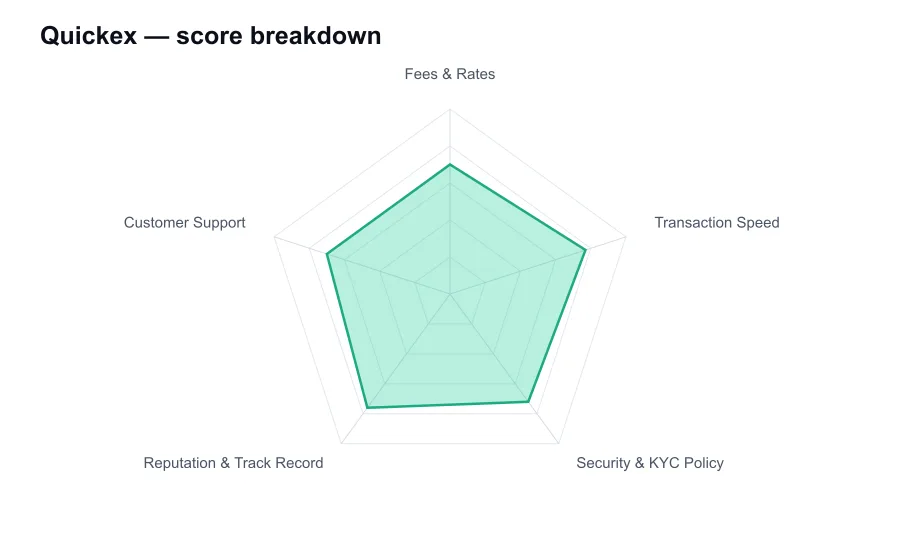
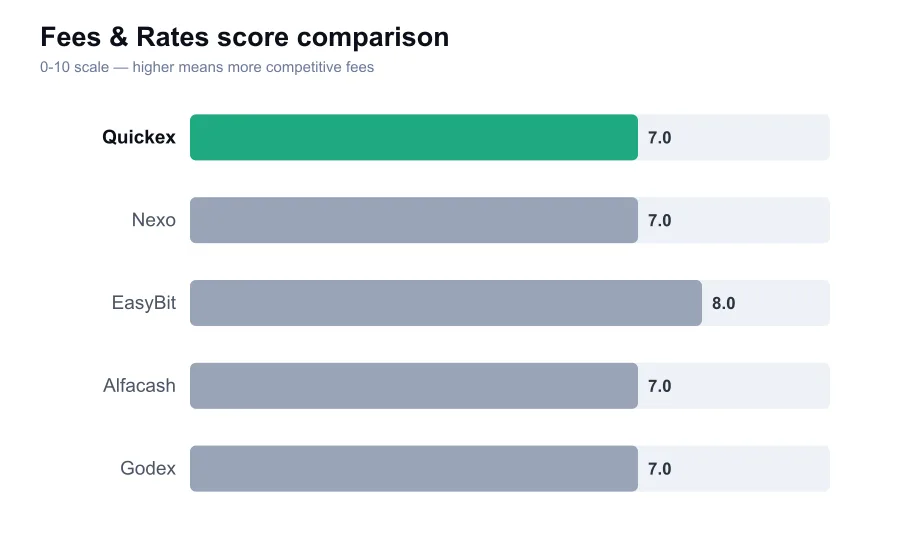
| Fees & Rates | 7.0 | Often competitive quotes, but the effective cost is rate-based. |
| Transaction Speed | 7.7 | Efficient processing after required blockchain confirmations. |
| Security & KYC Policy | 7.2 | No standing custody, with risk controls and possible verification. |
| Reputation & Track Record | 7.6 | Longer operating history and broader public user footprint. |
| Customer Support | 7.0 | Established online support and useful order tracking. |
In-Depth Review
Quickex is one of the better-known account-free crypto exchange services, built around rapid wallet-to-wallet conversions rather than conventional spot trading. It has been operating long enough to be familiar to many users of the instant-swap category, and that matters. In this corner of crypto, survival through several market cycles is more meaningful than a glossy launch page. Quickex is still not a bank or a regulated brokerage, but it is a more established name than many newer aggregators.
The product is intentionally uncomplicated. Users select the asset and network they are sending, enter the asset they want to receive, supply a wallet address, and fund the displayed order. There is no trading terminal to master and no custodial balance that encourages users to leave funds behind. For a person moving between self-custody wallets, that is a practical design. It is also why Quickex should be judged as an execution service, not as a full investment platform.
Quickex supports a substantial range of cryptocurrencies, including large-cap coins, stablecoins, and many tokens. The strongest experience is on liquid pairs where several market makers can compete to fill the order. BTC, ETH, LTC, TRX, SOL, USDT, and USDC routes are the obvious candidates. Very small tokens deserve caution. Availability can change, minimums can be higher, and a route that looks listed may be dependent on temporary third-party liquidity.
Fees are built into the conversion quote, a standard practice among instant exchangers. Quickex does not operate like a traditional exchange charging a plainly posted maker or taker schedule. Instead, the displayed rate incorporates the platform margin, liquidity cost, and usually the cost of sending the outbound asset, while the sender still pays the fee to broadcast the deposit transaction. This is convenient, but it makes percentage claims less useful than a direct quote comparison.
On ordinary pairs, Quickex is often competitive rather than consistently cheapest. That is a fair assessment. It can beat a rival at one moment and lose to another a few minutes later because suppliers, network conditions, and inventory move constantly. Users who care about every basis point should open two or three swap pages before sending. Users who value a familiar interface and a quick flow may accept a slightly weaker quote for the convenience.
The service offers fixed-rate and floating-rate transactions. Fixed rate is the better feature, and Quickex deserves credit for making it prominent. In a fixed order, the provider locks the exchange terms for a stated period provided the correct amount arrives in time. That reduces the nasty surprise of sending Bitcoin during a price swing and receiving substantially less value after confirmations. Read the time limit carefully, because a late or incorrect deposit can move the order outside that protection.
Quickex is generally fast after the incoming deposit obtains the required confirmations. On a liquid Litecoin or Tron route, the practical waiting time can be short. Bitcoin and Ethereum mainnet are different stories, especially in congested periods. The platform cannot control block production, wallet congestion, or a wallet that uses an unusually low mining fee. Anyone promising instant completion regardless of chain conditions is overselling the reality.
What Quickex does reasonably well is provide order information and a clear transactional path. The swap has an identifier, and users can track its progress rather than wondering whether a deposit address was simply a black hole. That sounds basic, but it is essential for a service processing irreversible transactions. The useful question is whether the order state reflects reality when something unusual happens. On standard swaps, it normally does. Difficult compliance or liquidity cases are naturally more variable.
Quickex does not usually require account registration or automatic KYC for standard exchanges. That is attractive to privacy-conscious users and removes the familiar exchange onboarding chore. It is not a promise that every transaction will pass without scrutiny. Like competitors, Quickex reserves the ability to request verification or additional information where risk controls are triggered. A customer with funds from a flagged source should expect this possibility rather than treating it as an arbitrary surprise.
Its noncustodial positioning needs a precise reading. Quickex does not hold a standing customer trading balance, and funds are intended to travel from one user wallet to another through the exchange process. During that process, however, the customer does send assets to a service-controlled deposit address. The counterparty risk is temporary, not absent. That is much better than leaving a portfolio on a centralized exchange, but it is not the same as an atomic swap.
The company has a stronger reputation than small anonymous exchangers because it has a longer visible history, a recognizable brand, and a sizable body of user feedback across crypto communities and review sites. That record includes complaints as well as praise, which is normal. The relevant pattern is that Quickex is a real operating service, not a disposable web front. Still, public reviews should be read critically because smooth transactions generate enthusiastic posts while complicated cases can take much more effort to resolve.
Support is available through online channels, and Quickex has historically positioned itself as responsive. For routine questions, that is usually enough. For a delayed exchange, the quality of your report matters: provide the order ID, deposit transaction hash, source address, amount, and screenshots. I would like more direct public transparency around average resolution times for exceptional cases, but that criticism applies to much of the instant-exchange industry.
Quickex makes the most sense for a user who understands networks and wants a fast conversion without an exchange login. Its fixed-rate option is genuinely useful, its transaction flow is mature, and its reputation is better than many no-name competitors. The limitations are inherent to the model: bundled pricing, third-party liquidity dependence, and potential compliance holds. It is convenient infrastructure, not a substitute for a highly liquid exchange for large execution.
My take is favorable with sensible limits. Quickex has earned a place on the shortlist for everyday crypto swaps, particularly if its live quote is competitive. I would use the fixed-rate route for a significant transfer and send a small test amount first if the destination chain is unfamiliar. I would not use it blindly for the cheapest possible execution or for funds that cannot tolerate a temporary hold. It is a solid service, but mature caution still beats brand familiarity.
Pros & Cons
| Pros | Cons |
|---|
Is Quickex KYC-free?
Quickex generally allows standard swaps without registration or routine upfront verification, but it can request information if its risk controls flag a transaction.
What is the difference between fixed and floating rates on Quickex?
Fixed rate aims to lock the payout if the correct deposit arrives in time. Floating rate changes with market conditions during processing.
How fast are Quickex swaps?
Many liquid swaps finish soon after confirmations. Bitcoin, Ethereum congestion, low-fee deposits, and manual review can take substantially longer.