Editorial independence: our scores and rankings are produced using the fixed criteria above and are not influenced by advertisers. This is an independent ranking site and is not operated by, or affiliated with, any provider we list.
Affiliate disclosure: some links on this page may earn us a commission at no extra cost to you. This does not affect our rankings.
Live market data via CoinGecko, for informational purposes only. Not financial advice.
| Best for | Not for |
|---|---|
| Competitive exchange pricing on many routes | Final rate can trail a spot exchange |
Criteria Breakdown
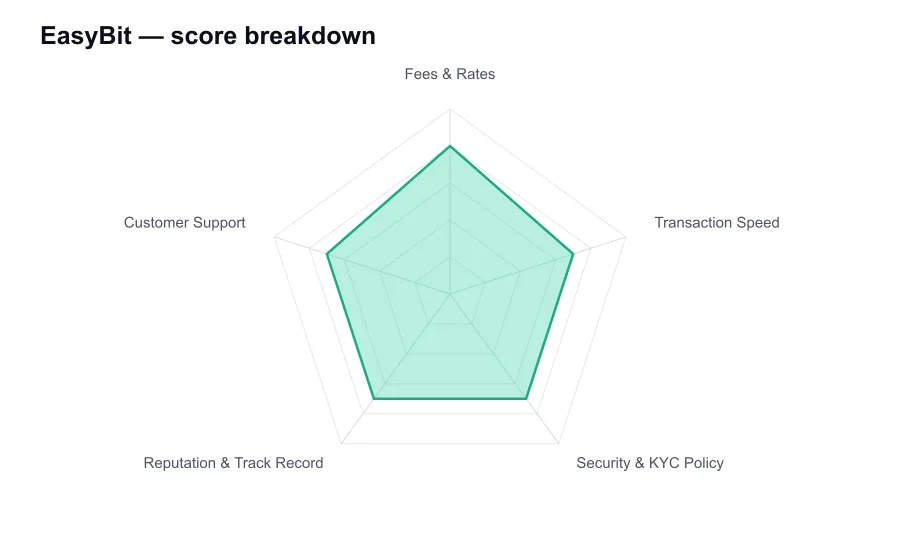
| Criterion | Score | Notes |
|---|---|---|
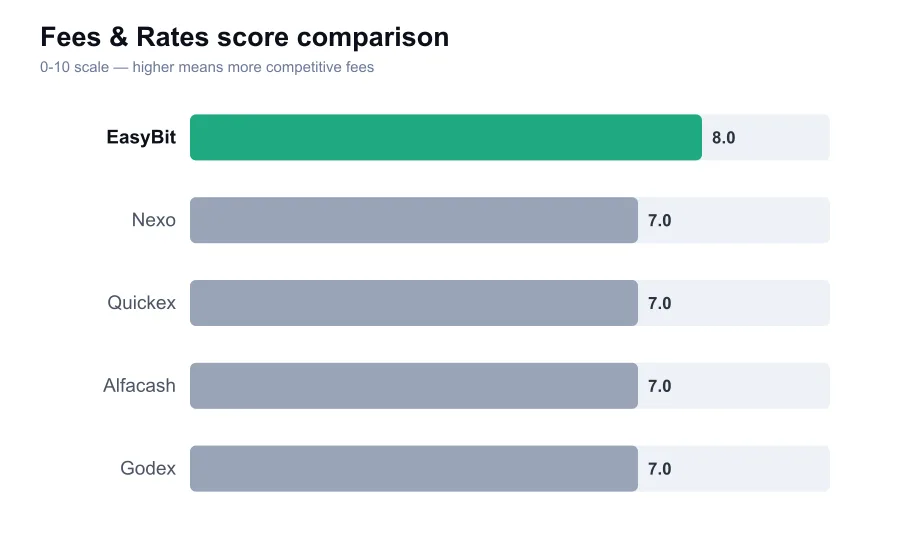
| Fees & Rates | 8.0 | Competitive quotes, with advertised 0.25% exchange fee. |
| Transaction Speed | 7.0 | Usually quick after required blockchain confirmations. |
| Security & KYC Policy | 7.0 | Noncustodial flow with risk-based verification. |
| Reputation & Track Record | 7.0 | Established instant-exchange presence since 2017. |
| Customer Support | 7.0 | 24/7 support and transaction status tools. |
In-Depth Review
EasyBit is a noncustodial instant exchange service aimed at people who want to swap coins without opening a traditional trading account. It occupies a useful middle ground between a centralized exchange and a self-directed decentralized exchange. You choose the asset you are sending, choose what you want back, provide a receiving wallet, and let EasyBit route the conversion. For ordinary wallet users, that is a much cleaner experience than managing an order book.
The company has been around long enough to be recognized in the instant-swap category, which matters. EasyBit is not in the same league of public scale as Binance, Coinbase, or Kraken, but it has a more established profile than a random conversion site with no history. Its product is intentionally narrow. You are not there for advanced charts, staking dashboards, or perpetual futures. You are there to exchange assets and leave.
EasyBit's fees are among its more attractive features, particularly for customers who pay attention to the quote rather than a marketing headline. The service has promoted a 0.25 percent exchange fee on certain transactions, but the practical cost still depends on the rate, liquidity source, network fee, and route selected. This is true of every instant exchanger. The only number that matters is the final amount promised to your wallet before you commit.
On common liquid pairs, EasyBit can be competitive with ChangeNOW and frequently more straightforward than services that bury their margin in a vague floating rate. It is not always the cheapest option. A centralized exchange can beat it easily if you already hold funds there and are willing to place a spot order, then withdraw. But that comparison misses the point for users who value a quick, noncustodial conversion and do not want to deposit assets into a custodial account.
The platform offers floating and fixed-rate options on supported routes. Floating rates follow the market while the transaction is being processed, so the received amount can move, sometimes noticeably in volatile conditions. Fixed-rate swaps provide more certainty, although the quote may include a premium for that protection and has a limited payment window. For a calm market, floating can be sensible. For a payment where the output amount matters, fixed rate is usually the better decision.
Transaction speed is generally good on assets with fast confirmation and deep liquidity. Once the deposit is detected and the required confirmations arrive, many swaps complete within minutes. Bitcoin is the obvious exception because network conditions and confirmation requirements can stretch the process. The service cannot make a slow blockchain fast. Anyone promising otherwise is selling fiction.
EasyBit does a better job than many small exchangers of making the transaction flow understandable. The exchange page gives customers a route, a send address, a receiving address, and status information rather than leaving them in the dark after payment. That does not prevent every delay, because partner liquidity and blockchain congestion remain real variables, but it gives users something to work with if a transfer takes longer than expected.
Security is solid for the category, with an important qualification. EasyBit's noncustodial model means it does not function like a savings account holding a standing balance under your login. That reduces exposure to the classic centralized-exchange failure where a customer loses access to pooled funds. Still, the coins are in the service's transaction flow after you send them, so users must protect themselves against phishing, copied addresses, and fake domains.
The company does not generally require a conventional account registration for a basic exchange, which is a genuine convenience. Privacy-minded users should not mistake this for a guarantee of immunity from compliance review. Like other serious instant exchangers, EasyBit can request identity verification if a transaction triggers its risk controls. That policy is more defensible than pretending AML obligations do not exist, but the customer experience depends heavily on clear communication and a fair path for resolving flagged transactions.
EasyBit's reputation is respectable rather than flawless. It has a visible history, recurring discussion in swap-comparison communities, and enough long-term presence to distinguish it from a throwaway site. Complaints do exist, as they do for nearly all conversion services. Delays, changed floating-rate outcomes, and verification requests tend to dominate them. Those are not trivial issues, but they are also not evidence by themselves that the business is unreliable.
Support is one of the reasons EasyBit remains viable against larger competitors. The site offers round-the-clock assistance and transaction-level contact options, which is what an instant exchange should provide. Response quality matters more than a claim of 24/7 coverage, and reports are mixed in the ordinary way for this market. Straightforward cases appear to be handled efficiently. Complicated compliance or partner-liquidity cases can require patience.
A practical user should always enter the destination address manually or verify a pasted address character by character, especially for large values. Confirm whether the route is fixed or floating before sending. Do not send from an exchange account if that exchange may delay the withdrawal, because an expired fixed-rate payment window can create an avoidable problem. These are basic habits, but they make a meaningful difference.
EasyBit is most convincing for someone holding coins in a self-custody wallet who needs a direct conversion without a lengthy onboarding process. It is less persuasive for active traders. If you trade repeatedly, an exchange with low maker fees, deep books, and limit orders will deliver better economics. EasyBit's convenience fee is reasonable for occasional use, not a substitute for a trading venue.
I like EasyBit more than many lesser-known instant exchangers because it has a clear purpose and does not pretend to be everything. The fee structure is competitive, fixed-rate functionality is useful, and its noncustodial workflow suits wallet users. The weaknesses are predictable: rates can be less favorable than spot trading, blockchain delays still happen, and a compliance check can interrupt the no-registration experience. For occasional swaps, it is a credible choice.
Pros & Cons
| Pros | Cons |
|---|
What fee does EasyBit charge?
EasyBit has promoted a 0.25 percent exchange fee, but the final cost also includes the quoted market rate, liquidity routing, and applicable network fees. Compare the final output amount before sending.
Does EasyBit require KYC?
Basic swaps usually do not require account registration or routine KYC. The service can request verification when a transaction triggers security or compliance checks.
How long do EasyBit swaps take?
Many swaps finish within minutes after the deposit receives required confirmations. Bitcoin, congested networks, low-fee deposits, and compliance reviews can take substantially longer.