Editorial independence: our scores and rankings are produced using the fixed criteria above and are not influenced by advertisers. This is an independent ranking site and is not operated by, or affiliated with, any provider we list.
Affiliate disclosure: some links on this page may earn us a commission at no extra cost to you. This does not affect our rankings.
Live market data via CoinGecko, for informational purposes only. Not financial advice.
| Best for | Not for |
|---|---|
| Useful fiat and payment-method coverage | Quote spreads can exceed exchange trading costs |
Criteria Breakdown
| Criterion | Score | Notes |
|---|---|---|
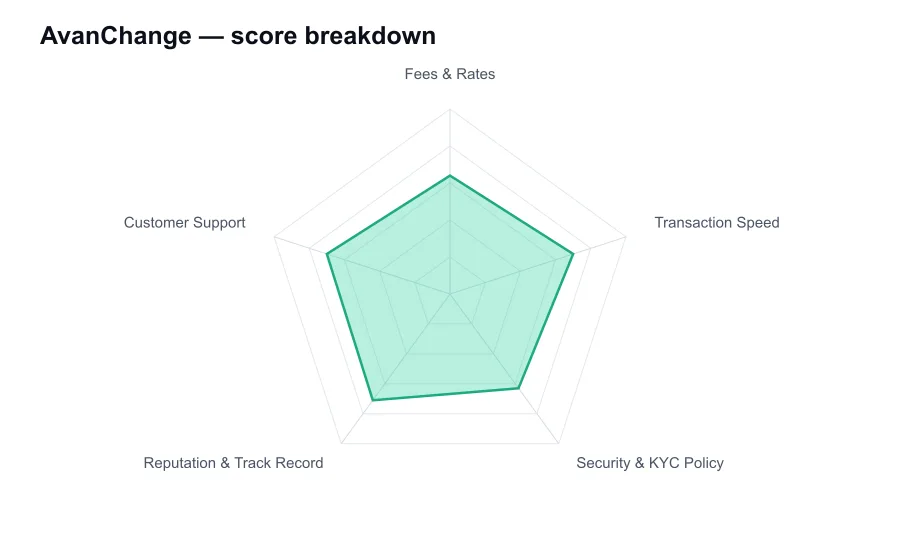
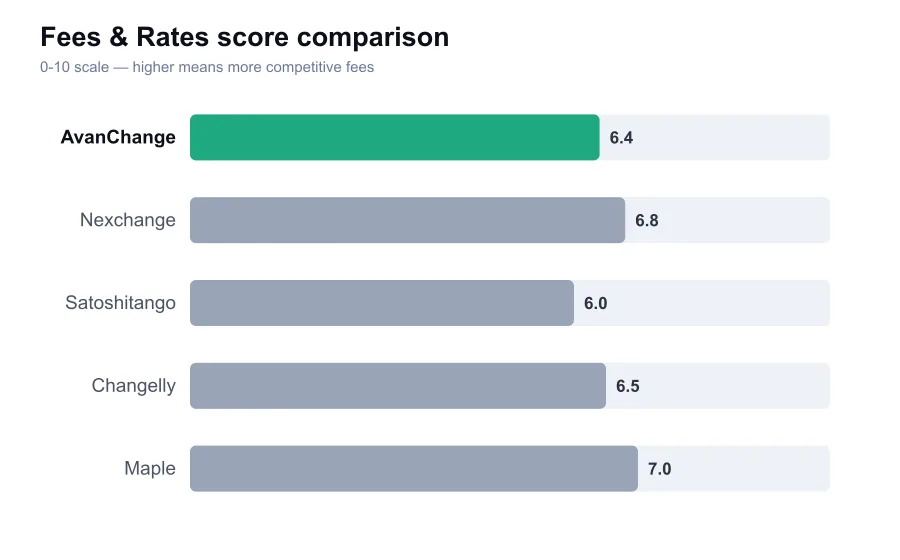
| Fees & Rates | 6.4 | Route value can justify quote-based spreads |
| Transaction Speed | 7.0 | Strong for routine supported payment routes |
| Security & KYC Policy | 6.3 | Use careful payment and address controls |
| Reputation & Track Record | 7.1 | More established exchanger-market footprint |
| Customer Support | 7.0 | Support matters for payment-route exceptions |
In-Depth Review
AvanChange is an exchange-office style provider aimed at users who need practical conversions between cryptocurrency and fiat payment methods, rather than a conventional trading platform. That distinction matters. It is built for execution of a requested route, often involving cards, banks, electronic wallets, or cash-related options, not for charting Bitcoin or running a portfolio. In its natural niche, AvanChange can be genuinely useful. Outside it, a larger exchange will usually offer lower trading costs and more formal market infrastructure.
The service's central proposition is access. Major exchanges are strong at liquid spot markets, but they do not always support every regional card, cash, or payment-system route customers want. AvanChange attempts to bridge that gap through an exchanger model. The model is familiar, but it is not frictionless. Users exchange some of the transparency and institutional depth of a global exchange for a more tailored settlement path. That can be an excellent trade for the right need, but it should be a conscious one.
Fees are best understood as part of the quoted exchange rate. AvanChange is not the kind of venue where a customer can point to a 0.16 percent maker fee and calculate the result precisely. The rate may include the provider's margin, payment handling costs, reserve exposure, and crypto network conditions. That is normal for this category, but it means the advertised direction should always be compared by final payout. A seemingly small rate difference becomes expensive on a sizeable transaction.
AvanChange has a better case than a generic instant swap site because payment-method flexibility can be valuable in its own right. If a customer needs to cash out a supported cryptocurrency through a route that a large exchange cannot provide, the service fee may be worth paying. Still, nobody should confuse availability with best price. Compare at least a few exchanger offers, account for card or bank charges, and ask whether the displayed rate is locked. For large transactions, an upfront confirmation from support is sensible.
The site is most compelling for users who understand exactly what they are trying to accomplish. A Bitcoin holder who wants a particular settlement method may find the workflow far more practical than moving money through several platforms. A short-term trader converting between BTC and USDT probably will not. Trading platforms generally offer tighter spreads, deeper liquidity, and clearer execution data for purely crypto-to-crypto activity. AvanChange should be chosen for its route coverage, not because it replaces a trading exchange.
Speed depends heavily on the direction. Crypto deposits can be detected quickly, but confirmation requirements remain outside the operator's control. Fiat payouts can be swift if a payment provider processes automatically and the order fits normal limits. They can also slow down because of bank fraud systems, nighttime schedules, manual review, or limited reserve. This is why any claim that an exchanger is instant needs to be read as a best-case description. The payout network has its own clock.
AvanChange's likely advantage is practical processing knowledge around its supported methods. That can make a routine order feel easier than attempting to navigate an international exchange withdrawal. But routine is the important word. A sender using the wrong card, omitting required payment details, transferring an incorrect amount, or using a third-party account can create a manual case. Customers should not assume the service can simply ignore payment-source rules because the original order page was easy to create.
On security, the right question is not merely whether the website uses encryption. Every reputable financial site should do that. The greater question is whether a user is comfortable sending funds to an exchange office that must complete the opposite side of the deal. AvanChange creates a temporary counterparty relationship. That is common and can work well, but it is fundamentally different from trading on a regulated exchange with a long corporate history or swapping directly through self-custody software.
The safer approach is to protect both ends of the transaction. Confirm the domain through a trusted source, verify every wallet address, secure the email account used for notices, and do not send screenshots or documents to anyone claiming to be support through an unsolicited messenger account. If a payment includes a memo, tag, or reference number, enter it exactly. These are not theoretical details. A single incorrect field is often more dangerous than a modest exchange-rate spread.
KYC expectations need to be realistic. AvanChange may allow users to create an order without registering a full trading account, but no serious exchange service can promise that every payment will avoid verification. Bank partners, payment processors, and anti-money-laundering controls can require a check. Users should read the current rules on source of funds, card ownership, identity documents, and transaction limits before paying. The time to learn that an order may require documents is before, not after, a transfer is underway.
AvanChange has a more defined presence in the exchanger market than an unknown, one-page swap operation. That gives it a modest reputation advantage, especially for users who can inspect its history on monitoring services and read current feedback. It is still not in the same reputation class as a major globally regulated exchange. The difference is not cosmetic. Larger firms have more public disclosures, more visible legal entities, broader incident records, and more established paths for resolving account disputes.
That gap does not make AvanChange unsuitable. It means the amount sent should reflect the available assurance. For a well-understood route and a moderate order, the service may be a practical choice. For a large business settlement, a property-related payment, or savings that cannot tolerate a delay, I would want a stronger contractual and regulatory framework. Exchanger reviews can show useful patterns, but they cannot turn a transactional service into a bank.
Support has particular importance here because nonstandard payment directions create questions that no automated interface can answer. AvanChange should be judged on whether it provides clear instructions before payment, gives an order reference, and can explain a delay in concrete terms. Good support distinguishes a blockchain confirmation delay from a bank hold. Poor support merely asks users to wait. Before placing a larger order, asking a direct question about reserve, processing time, and payout method is a sensible small test of responsiveness.
My assessment is favorable but conditional. AvanChange appears better suited to its specialist role than to broad claims of being a universal crypto exchange. It can solve real fiat conversion problems, and that deserves credit. At the same time, its quote-based pricing, counterparty exposure, and possible verification requirements mean users should approach it as a carefully managed payment transaction. It is a useful option for a specific route, not a place to stop comparing offers or abandon basic caution.
Pros & Cons
| Pros | Cons |
|---|
How does AvanChange make money?
Its effective charge is generally included in the exchange rate, alongside network and payment-method costs. Compare the final payout, not only the displayed rate.
How fast are AvanChange payouts?
A routine order can be processed quickly, but crypto confirmations, bank schedules, fraud checks, payment-provider rules, and manual review can add time.
Will AvanChange require KYC?
An order can be created without a full exchange account, but verification may still be required by compliance rules, banking partners, or a transaction review.
What should I check before paying an AvanChange order?
Confirm the payment method, wallet network, exact amount, rate validity, reserve availability, recipient details, and any card or bank ownership requirements.