Editorial independence: our scores and rankings are produced using the fixed criteria above and are not influenced by advertisers. This is an independent ranking site and is not operated by, or affiliated with, any provider we list.
Affiliate disclosure: some links on this page may earn us a commission at no extra cost to you. This does not affect our rankings.
Live market data via CoinGecko, for informational purposes only. Not financial advice.
| Best for | Not for |
|---|---|
| Compares multiple instant swap providers in one screen | Final execution depends on a third party provider |
Criteria Breakdown
| Criterion | Score | Notes |
|---|---|---|
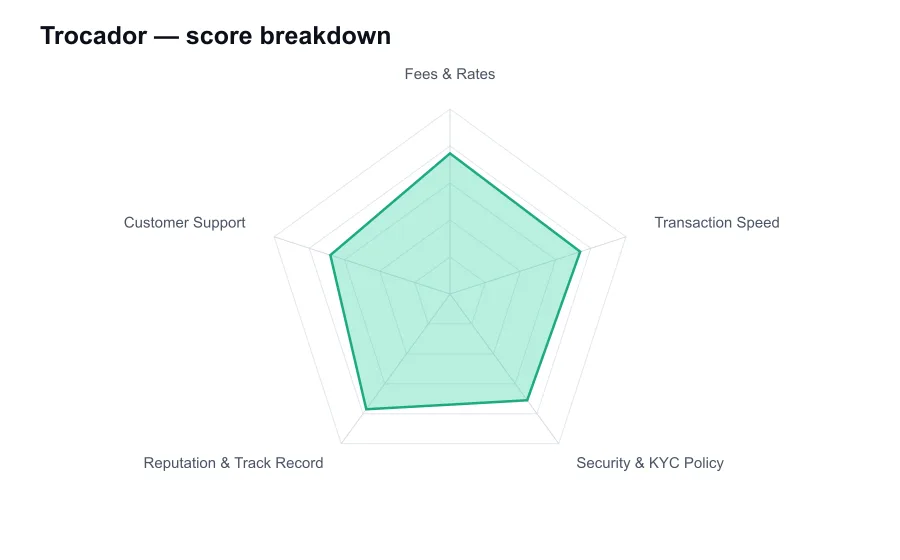
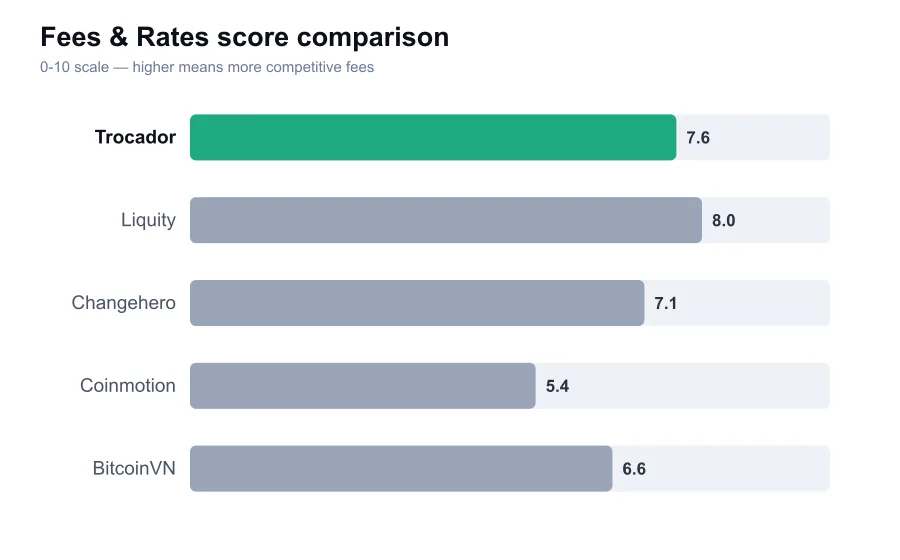
| Fees & Rates | 7.6 | Useful provider comparison, but spreads and service fees vary by route |
| Transaction Speed | 7.4 | Liquid swaps often settle quickly, provider delays remain possible |
| Security & KYC Policy | 7.1 | Noncustodial design, but partner AML checks can still interrupt swaps |
| Reputation & Track Record | 7.7 | Established privacy oriented aggregator with visible provider comparisons |
| Customer Support | 6.8 | Helpful mediation, but it cannot overrule a partner's compliance hold |
In-Depth Review
Trocador occupies a useful, slightly unusual corner of the crypto exchange market. It is not an exchange in the conventional sense, and it does not run an order book or hold a customer balance. It is a swap aggregator that compares offers from a group of third party instant exchange partners, then sends the user to the selected provider for settlement. For people who want to exchange coins without opening an account at a major centralized platform, that model has real appeal.
The site is built around a simple promise: show competing exchange quotes in one place and let the buyer decide whether price, privacy, or a particular provider matters most. Trocador lists both standard offers and providers marked as privacy focused. That is more useful than it sounds. A user swapping BTC into XMR, for example, can quickly see that the cheapest quote is not always the provider with the least intrusive verification history.
Its rates are usually competitive, but I would not call Trocador the automatic cheapest route. The quoted amount already includes the liquidity provider's spread and network costs, while Trocador may add a small service fee unless the user chooses an offer that absorbs it. The platform has historically described its own fee as around 0.5 percent, with discounts available through its affiliate arrangements. In practice, the final quote matters much more than the headline fee because partner spreads vary sharply by coin, liquidity, and network congestion.
That aggregation can save money versus going blindly to ChangeNOW, SimpleSwap, or a similar one stop instant exchanger. It also exposes an inconvenient truth about this market: the same swap can differ by several percentage points between providers. Trocador makes those differences visible. That alone is valuable. Yet it is not a magic price engine. During a volatile move, a fixed rate quote can carry a larger premium, and a floating rate quote can settle below the number someone saw when they clicked.
The fixed rate option deserves attention. It is the sensible choice for a larger swap or a transaction where a precise output amount matters, but it is often less attractive than a floating quote. Fixed rates are only honored for a limited deposit window, commonly around 10 to 20 minutes depending on the underlying service. Send late, send the wrong asset, or omit a destination tag, and a supposedly straightforward swap becomes a manual support case.
Speed is similarly dependent on the selected partner rather than Trocador alone. Straightforward swaps between liquid assets, such as USDT, LTC, ETH, BTC, or SOL, can finish in ten to thirty minutes after the incoming transaction confirms. Bitcoin deposits naturally take longer, and tokens on congested Ethereum can turn a quick swap into an hour or more. Trocador's comparison page is refreshingly candid about estimated times, though estimates are not promises.
The biggest strength of the model is custody. Trocador does not ask users to preload a balance, and a normal transaction sends coins directly to the chosen exchange provider's deposit address before the output is delivered to the user's wallet. That materially reduces the risk of leaving funds parked on a small exchange. It does not remove counterparty risk, however. For the duration of the swap, the selected provider controls the transaction flow.
That distinction matters because Trocador itself is not a guarantee against a partner's compliance checks. The platform does not generally impose account registration or routine KYC, which is why privacy minded users are drawn to it. But its providers use blockchain monitoring and fraud controls. A deposit can be paused and documentation requested if it triggers an AML review. Anyone presenting Trocador as a guaranteed no KYC escape hatch is selling a fantasy.
The privacy filters are helpful, but they should be read as practical signals rather than legal commitments. Trocador's privacy ranking reflects information and policies around its partners, not a binding assurance that no transaction will ever be reviewed. Users dealing with funds from exchanges, gambling sites, sanctioned regions, mixers, or high risk DeFi contracts should expect scrutiny somewhere in the chain. Splitting transactions to evade controls is not smart and can make a review worse.
Trocador has built a respectable reputation among noncustodial swap users, especially in the privacy coin community. It has been operating for years, publishes a provider comparison system, and has become more recognizable than many anonymous instant swap websites. Its public identity and transparency are still modest compared with a regulated exchange such as Kraken or Coinbase. That is not necessarily disqualifying, but it sets the right expectation for the level of recourse available.
A recurring complaint about Trocador tends to involve the underlying provider rather than the interface. Users may see a good quote, complete a deposit, then find that the provider has delayed settlement or requested verification. Trocador can mediate and put pressure on partners, but it cannot instantly force another company to release funds. The aggregator has an incentive to keep unreliable services off its list, yet the user is still exposed to the weakest operational link.
Support is better than many privacy oriented swap sites, though it is not concierge service. Trocador provides transaction tracking, provider details, and support channels that can help chase a delayed order. Responses are often described as practical, particularly when the issue is an identifiable provider delay. Complex compliance holds are a different matter. Support can explain the status, but it cannot override an AML decision or turn an incomplete refund into a quick resolution.
The interface is clean and much less intimidating than using a decentralized exchange across several chains. That said, experienced users should take advantage of the information on screen rather than treating the green best rate label as the whole story. Check whether the quote is fixed or floating, inspect the provider, confirm the network, and test a new route with a small amount. Those few minutes are the difference between using an aggregator intelligently and merely using it conveniently.
Trocador is at its best for self custodial users who value choice and do not want to open an account just to swap assets. It is especially compelling for comparing routes into privacy coins or avoiding needless exchange deposits. I would not use it for a life changing sum, an urgent trade during a market spike, or a transaction where a KYC hold would be financially disastrous. For ordinary wallet to wallet swaps, it is one of the better aggregators, but the provider behind the quote still matters more than the Trocador logo.
Pros & Cons
| Pros | Cons |
|---|
Does Trocador require KYC?
Trocador does not normally require an account or routine KYC. The exchange provider handling a specific swap can still pause a transaction and request documents under its AML policy.
Does Trocador hold my cryptocurrency?
It does not operate a user balance like a centralized exchange. During a swap, funds are sent to the selected third party provider, which means that provider has temporary control of settlement.
Why is the final amount different from the quote?
A floating rate changes with the market and can move before settlement. Network fees, liquidity conditions, and sending outside the deposit window can also affect the final outcome.